
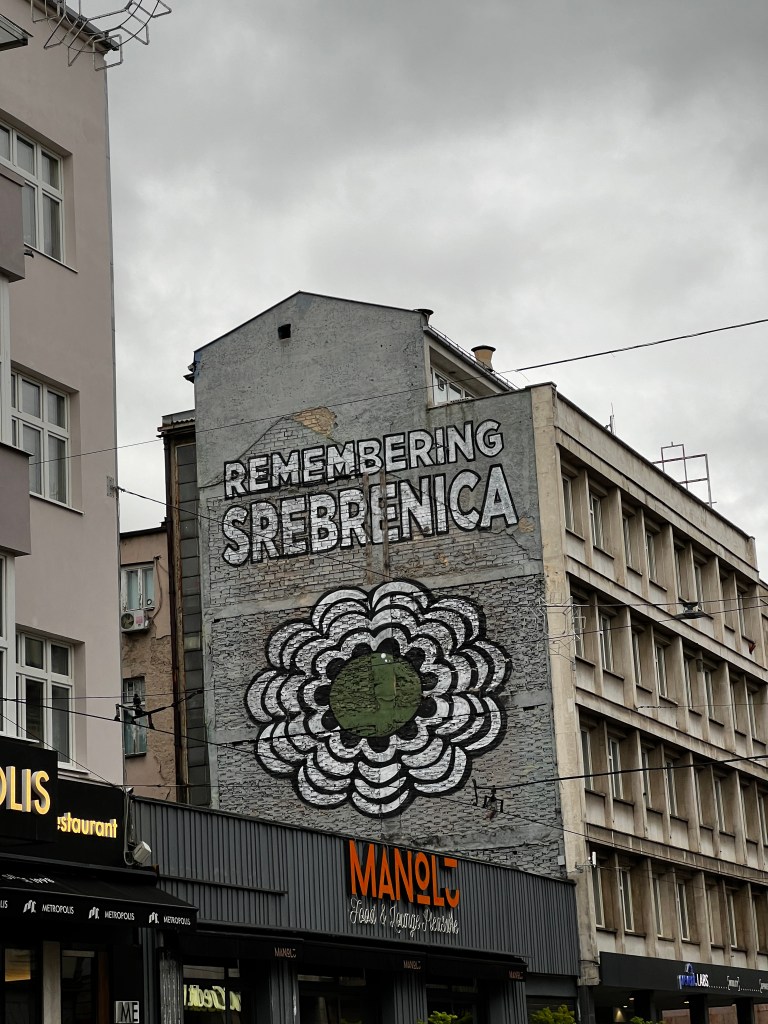
Remembering Srebrenica

Sarajevo
I turned a corner and walked straight into a wound.
Not one still bleeding – but one kept visible, like a scar that insists on being seen.

This mural doesn’t whisper.
It speaks loudly in white, black, and green – the colours of remembrance, of grief, of survival.
The flower is a Srebrenica daisy – each petal a life, a name, a prayer for what should never have happened and must never be forgotten.

What moved me was not just the message,
but its placement:
on the skin of a living city,
above a restaurant, beside windows,
between trams and errands.
Grief, in Bosnia, walks with you. It has a postal code.
It asks nothing but that you don’t look away.

This image is not only part of Imperfect Light—
It is a promise:
That I, too, will remember.
Not only the tragedy,
but the strength it took to keep
blooming in its aftermath.

This post is part of the “Imperfect Light” series – you can read the introduction here.

Inat Kuća – The House of Spite, Sarajevo

Inat Kuća – Spite House

I didn’t take this photograph because the building was beautiful – though it is. I took it because of the story it carries.

This is Inat Kuća, the “House of Spite” – a name born from defiance. When the Austro-Hungarian authorities planned to build the City Hall across the river, a stubborn houseowner refused to move unless they relocated his house, brick by brick, to the other side. They did. And he watched it rise from across the Miljačka, his spite immortalized in wood and stone.

I was drawn to the green bay window jutting out like a jawline, unbothered and proud. The sun carved shadows across its face, as if underlining the house’s character. I didn’t edit those lines away. I wanted the grit. The texture. The unapologetic presence.

In that moment, the house reminded me of Bosnia itself: unyielding, poetic, and full of stories that begin with resistance and end in resilience.

This post is part of the “Imperfect Light” series – you can read the introduction here.